Tuesday, January 17, 2012

Session 3: "I commend you on your forgiving nature...."

After a full session of character-transfers from 4th to Pathfinder, we were ready to get playing again.  The choices of the players for what to make in Pathfinder really interested me, so I’m going to relate what the player was, and what they became.

Ari went from being an Ardent to being a Two Weapon Ranger.
Chris went from being a Rogue to being a…. Rogue.
Tami went from being a Seeker to being a Zen Archer
Morgan went from being a Swordmage to being a Magus (more on that switch later)
And finally
Adam went from being a Vestige Pact Warlock to being an Oracle.

And this session also saw the introduction of a new party member.  Otis brings in a Soulblade.

Years and years ago, I ran a DnD campaign that centered on the player characters being the “chosen ones” of some ancient prophecy.  Without giving too much away, there’s a thin layer of this ridiculous trope (though much inverted and twisted) going on with this campaign, as is probably plainly clear.  Halfway through the first campaign like this, when I was fairly inexperienced as a DM, I ran into a huge road block.  One of my players had to quit, and we added a new player in their place.  All of a sudden, Gortak the Warrior-priest of the Five Chosen was… running a bar in Odekkan, but Chumba the Barbarian was hanging around with the other Four Chosen now instead.  It was sort of like if that guy from Extreme joined Van Halen for some reason.

I struggled to find an excuse, because I’d written myself into a corner with the whole Five Chosen thing.  I am still embarrassed by the way I handled that.  I sorta hand-waved it for the party, saying “you were mistaken!  Despite 16 levels of adventuring with Gortak, he was never the prophesied warrior (that the prophecy was written to resembled by the DM), but instead, Chumba is (even though Chumba doesn’t fit any of the prophecies..)!”

So, with that in mind, I left myself some wiggle room with the characters this time.  I left a valid in-story way that others could join, without lessening the special uniqueness of the Character’s place in the Universe.  Bringing in Otis wasn’t going to break the game this time.

Otis woke up very similarly to the other five.  Naked and completely devoid of any idea as to where he’d come from.  There was also a sharp pain in his chest from a Y shaped wound.  Only instead of cold and in a stone cellar, Otis was half-buried in a pile of slowly burning bodies.

As he clawed out of the body pile, he surveyed where he was.  He was outside the walls of the city.  It, apparently, is a walled city, the walls being made of a slightly-polished white stone, like limestone.  While he was specifically in a pile of bodies, that wasn’t the only thing burning in this apparent garbage dump.  There was an empty cart with a broken wheel just a hair away from the body pile, which Otis chose to hide in when he noticed a cart coming close to his location.

In the cart was a girl, roughly 13 or 14, with kinky red hair.  It is incredibly hard to find a picture of a red haired girl that isn’t pornographic or, you know, sexualized in some way, so you’ll just have to use your imagination on this one.  She was driving the cart, and there was a pretty hefty load in the back end of the cart, covered with a white canvas tarp.

The girl pulled her cart right along side the broken one that Otis was hiding in and pulled back the tarp.  Under the tarp was a stack of five naked bodies, each with a Y carved in their chest, but not sewn up the way that Otis’ was.  As the red-haired girl struggled to get a handle on the feet of the first body, she noticed Otis laying, motionless, in the cart next to her.

She swore and hopped over to that cart, grabbing Otis’ feet and started to yank.  That’s when Otis decided it was time to “wake up.”

He quickly clamped a hand over her mouth and assured her he did not want to hurt her, and after a promise to keep her mouth shut, the hand was removed.

The girl was noticeably dumbfounded, eyes wide and mouth hanging open.

“But you were dead,” she said, “I stabbed you just to be sure.”

With just a bit of questioning, Otis was able to find out a few bits of information.

1) she was hired by an unknown party (an old man in brown clothing, so that should narrow it down…)
2) she had loaded four of the dead bodies up on the first trip, and loaded the last five for a second trip (she’s also had help with it, and that help was supposed to be waiting for her at the burn pile).
3) this was the typical method of body disposal in Eridu (which is the city’s name)

Armed with these things, Otis managed to convince her to give him a ride into town to where she had collected the bodies from.  After he’d helped her dispose of the other bodies.  And used the tarp to cover his nakedidity.

It took a bit of time to get back there, a good hour (they were just sunset-wise of the city, and the place they were going was right near the walls on that side of the city).  On the ride, the girl (who told Otis that her name was Kindee) remembered that she had actually found a roll of hide with some writing on it.  That writing was the exact same list that the previous five had found, but with one difference.  The word Melamu was also crossed off.

Kindee brought Otis to a slum near a bazaar in the city and, while she intended to take him to the cellar where she had collected his corpse, she was barred from getting too close.  It seems that a Cleric had been dumped into the canal that runs parallel to the mountain foot here.  The Cleric had been cut into pieces and shoved into a barrel.  As a result, traffic was snarled as they searched for clues.

Kindee, who was proving to be quite connected with the urchins and denizens of the streets in the area, was able to worm she and Otis close to the body to get a look.  What Kindee saw was a rather ugly man cut into lots of pieces and shoved brutally into a pair of barrels.  Otis saw something completely different.  A weird mix between a human and a dog-like-thing sawed into parts and shoved brutally into a pair of barrels.

“Is that sort of thing normal?”

“Well,” Kindee replied to Otis’ question, “we do get our share of murders, and Smokeside is pretty violent sometimes, but this is brutal even for here.”

“No,” Otis explained, “the fact that he’s got a dog face.”

“Well, sure, he needed a save, but there’s a lot uglier down here than him.  Wouldn’t call it that unusual.”

While Otis was trying to describe to Kindee exactly what he saw, a street urchin scuttled up to her.

“Them that did this, we know where they are.  We could sell them to the Church, but one of them shot lightning from his hands.”

Otis, being far more perceptive than he felt he had any right to be, again cajoled Kindee into leading him where he needed to go.

The rest of the party had decided that, for safety purposes, they should not all stay in the same place that night.  Adam, Tami, and Morgan stayed in one slum of an Inn in a “dry” (meaning can’t be reached by boat) section of town, while Chris and Ari found places in a soup-shop/bunk house.

Taking a moment to describe the sort of place I’d given Chris and Ari as their lodging.  It was essentially an open floor plan in two floors.  The bottom floor was all benches and tables except for the giant pot of stew simmering over a low fire in the middle.  While all of the vegetables and meat (what little there was) was pretty low quality (the meat in there probably came off of rats or pigeons), it smelled excellent and tasted even better.  Like sweet curry.

It was to the bunkhouse that the urchin led Otis and Kindee.  This is how I described the scene to Chris and Ari.

“The urchin you hired earlier in the day to carry your message to the others comes back in and makes a bee line to the bench you’re standing on.  He informs you that someone’s here to talk to you.  When you look at the door again, a young girl, probably about 14, with frizzing red hair and bright green eyes is looking at you with a tilted head.  Standing next to her is one of the soldiers you killed in your first minutes of consciousness.”

Chris, Ari, and Otis found a spot as secluded as possible on a bench in a corner, Kindee joining them without invitation, but also without a word of protest from any of the three.

It was one of those conversations that I’d hoped to have in the group with a premise like this.  Everyone calmly discussing how little they remember of their own deaths and assuring each other that it isn’t necessary to apologize for being the cause of said deaths.

Soon the three plus Kindee headed across the street and a few doors down to find Adam, Chris, and Morgan.

The discussion had three memorable moments from my perspective (though I encourage my players to add to these accounts if they so-choose).  First, Otis revealed the bit of skin with the list on it, and, when the group compared his list to their own, a conclusion was drawn: the list was a list of names and the extra name on Otis’ list was meant to indicate that Otis was Melamu.

Otis, from that moment onward, decided he was going to go by the name of Mel.  Quickly, Ari decided she was claiming the name The Unforgiven (though the party shortened it to Forgi).  Chris decided that none of the names sounded right, and just went with Alic instead.

Second, Ari asked Kindee “do you know what the names are on this list?” and showed her the list.  Kindee got real quiet and real grim.  She bit her lower lip and said “I can find you someone that can explain it better….”  Which set up the next scene.

The third thing that happened was one statement from Tami.  You see, it was determined that Tami was the one who had killed Mel (Mel) with her bow.  Tami responded to this revelation with the statement “I commend you on your forgiving nature.  It wasn’t personal for me when I shot you with that arrow.”

I laughed and handed out blue chips for that.

The party decided to call it a night until Kindee could get the information they needed.  Oh, and of course, Kindee made sure she got paid for her services of finding them information up front rather than after the fact.  She’s a smart business woman.

While the other five slept in beds (or cots…), Mel (Otis) seemed to be fine with the idea of finding a corner in an ally to crash in.  While he was sleeping, someone attempted to steal what little money the rest of the party had given him to get some food.  Startled, Mel (Otis) lashed out to defend himself, creating a blade of pure white light.  Before he could restrain himself, Mel (Otis) had killed his intended thief.

The next morning Kindee was waiting in the pot shop, enjoying a bit of breakfast.  Everyone sat down and, as if on cue (because it totally was), a pack of children swarmed the shop, making a ruckus.  While the children were causing trouble, a new adult person came in and moved right to Kindee’s table.  The man was on the wrong side of forty, but not by much.  He wore a simple brown over-cloak, but as he sat, the players noticed cloth of crimson under the brown fabric.  Without preamble, he explained the question he was brought in to answer.

“Those names, as hidden as they’re supposed to be, are the names of the Nine.  The Ennead.  They represent the end, but also completeness.  There is no digit after Nine, but every multiple of nine produces an nine-product equation.  Nothing comes after nine, but nine is the result of everything.

The Church was created for no other reason but to prevent the end of all things, the Moment of Nine.  The Ennead.  We profaned their temple and made it our own.  We hid the names of the Nine, but that’s like telling people to stop seeing the color Red.

In recent years, a group, resisting the way that the Church has left their sanctioned duty of preventing the Ennead, has taken the symbol of the End of All Things and co-opted it for themselves.  They wear the nine-pointed-star in an attempt to stir the hearts and minds of people.  It is, more or less, working.  The Nine Points Rebellion has been more successful than any previous.  And by “more successful” I mean they have yet to be wiped out, not that they’re enacting any sort of change.”

When asked for more information, the man, who had revealed that he himself carried a nine pointed star under his clothing (as did Kindee), indicated that he had already risked too much telling them what he had, but for love of Kindee (and an owed debt), he gave them a way to contact someone within the actual Cult of the Ennead, and assured them that Kindee could get them in touch with the leadership of the Nine Points Rebellion.

Much discussion followed, but eventually they came to the conclusion that it was the cult they wished to speak to first.  So off they went.

Yes, I created a religion around math…

Wednesday, January 11, 2012

Game 2: "A General High-Grade Spectacle of Annoying"

A long time ago, I was in a D&D group (3.0) with a real problem; we were great friends.  We loved to just hang out and talk and chit chat.  This meant that, even though game was supposed to start at 2pm (it was a Sunday afternoon game), it would almost never get started until at least 3:30.  It was as frustrating as it was enjoyable, both for different reasons.  We would false start a dozen times, and always get dragged back out of the game to continue our friendly banter.

That group never real got over it, but it was a concern I’d always have stick in the back of my mind.  How do I make sure that, when the game is supposed to start, the game can start?

I read an article, I think it was by Monte Cook (though I could be remembering wrong) was that one thing he tried to do to get everyone into the game right away was always have a reason to get them rolling dice as soon as possible.  Give them a skill to make, or something.  He said that dice rolling usually gets people paying attention and in the right mindset.

So, from that moment onward, I have strived to always end sessions right when a fight was about to happen, so I could say at the start of the next session “roll initiative.”

And that’s what I did.

“Roll Initiative.”

This was a pretty straight forward fight, to be honest.  The characters had to face off against the Cleric from last game.  As soon as the table got turned over, people started scattering, so there were no bystanders in the bar at the time that the lightning started to fly.

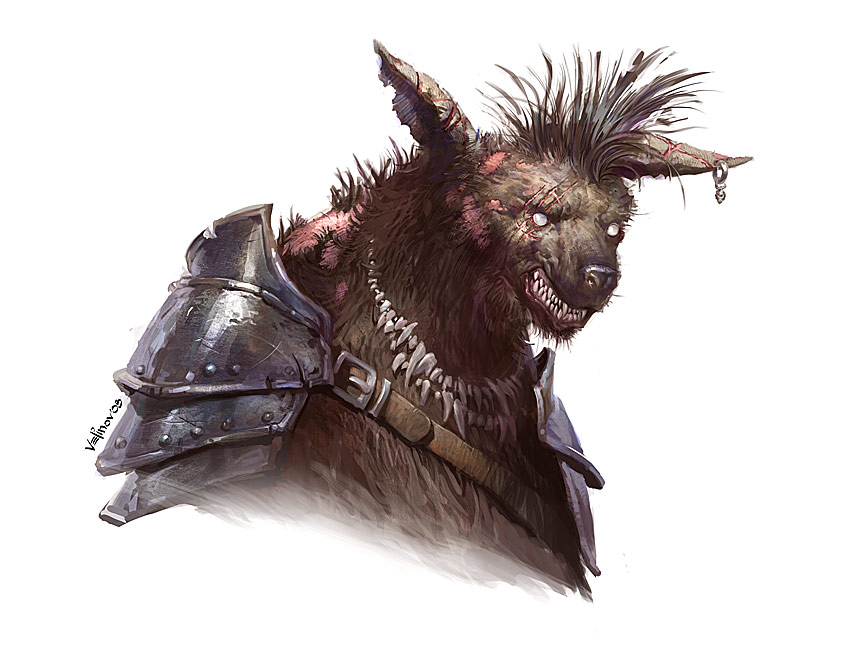
One interesting thing started to happen as they attacked the Cleric.  When he attacked, and when he was attacked by certain members of the party (Ari, at the time, was an Ardent, so she did Psychic damage), his appearance would change.  He appeared to have thick black hair with darker spots, and a face that was a bad mix between a mut dog and a hyena.  Those of you familiar with D&D monsters should recognize a Gnoll.


When they’d finally overcome the Cleric, he was the black furred dog-man, and did not change back.

I should add at this point that this was a 4th Edition game (the last one we did), with a player who’d never played Dungeons and Dragons before playing a controller.  Combat in 4th Edition is, by and large, a lot longer of a process than combat in any other edition, and add to that the fact that we were training a new player how to do it, and combat took up a huge portion of the time we have to play.

So, with a dead gnoll at their feet, and not having a clue what a gnoll is (and thinking this is horribly weird, because it is), the party scrambled.  They felt the need to hide the body, thinking that they’d be accused of something (not sure what) if someone found this dead dog-man that they’d killed.

Ari and Tami took the initiative here and took to the streets, making a ruckus a block or so away to draw people’s attention.  I think the term used was “a general high-grade spectacle of annoying.”

While their women-folk were playing distraction, the men folk got around to the hard labor of doing something with the body.  They found a barrel that was mostly empty in the back of the bar and proceeded to try to shove the body into the barrel.

And promptly failed miserably.

They failed so hard that they broke the barrel and had to find another.  Luckily, it was just before delivery (in my mind, like with the water bottles at work, the delivery man for the wine takes the casks that are empty and replaces them with the full ones, keeping the barman at the approved of levels of wine at all times), so they found a few more barrels.

I imagine the three of them standing around a dead gnoll in the middle of a bar, one scratching his chin, the other scratching his head, and the third shrugging as he knelt and began hacking the gnoll’s limbs off.

Yeah, Adam, and I quote here, “quartered the gnoll,” so it would fit into the barrel more easily.  The rest of the menfolk shrugged right along with him and helped.

Meanwhile, Tami and Ari’s distraction was doing its job, but there’s only so much one can do with “general high-grade annoying” before people just move on.  And move on they did.

By the time Adam and Morgan rolled the gnoll parts-filled barrels to the canal just outside the bar, people were already milling about again.

With a kick, the gnoll’s body was disposed of (for now…), and the group was left with the question of “what next?”

It was generally accepted that wearing the clothing they had donned in order to avoid attention was, in fact, going to do just the opposite, so they all set out to get themselves clothing.

Adam and Tami went shopping.  This is when Adam, from somewhere deep in his soul, decided that he wasn’t going to wear rags.  Oh no, he was used to, and wanted, fine clothing.  Higher the quality the better.  He wasn’t sure why this was important to him, but it was.  At the same time, Tami started to feel pretty claustrophobic.  She was feeling like there were too many people in this damned city, and all of the buildings were too close together.  She just wanted to be able to see a tree and the sky.

This was the first inkling of a hint of what they may have been before they became the PC’s.  Adam later discovered a tattoo, matching the downward arrow, on his left hip.

Through a little charade, Adam was able to convince a shop owner to sell him tailored clothing of a particularly high quality, on the promise of payment upon delivery.  Tami, as well, was given a pair of clothing that much upgraded her current armor/tabard ensemble, though she accepted it only reluctantly.

Morgan took things into his own hands rather than trust the hands of others.  With a little scrounging, he managed to get his hands on some thread and a needle.  Discovering a skill that he perhaps used prior to his time as… whatever he is now, Morgan used the scraps of clothing left from the armor and the tabards to make himself a new set of clothing that is less conspicuous than it was.  He turned out to be quite good at sewing as well.

Chris and Ari took off in a different direction, since the two of them had never worn the tabards and didn’t feel the need to make themselves less conspicuous.  They did, however, feel the need to arm themselves.  Chris bought himself a whole battery of daggers while Ari bought herself a pair of maces.

Ari also put a bit more effort into exploring than anyone else at that point.  With a little detective work, she found a temple, appearing to be a nine-sided building, atop a fairly large hill closer to the center of the city.  As she got closer to the building she started to come to the conclusion that it was some sort of temple.

Atop the building were nine statues, each different but in roughly the same Our Christ the Redeemer pose, carved out of some sort of black material.  Each statue wore shackles about their wrists that chained them together and to the building.  The shackles were clearly crafted later, and to the scale of the statues (the afor-mentioned Our Christ the Redeemer comes to mind…).  Around the building were black shrouds of cloth covering something that couldn’t be seen.

With the sun setting, Ari broke off exploration with the intent of heading to the temple on the hill the next day.  When she shared her observations with the rest of the group, they pretty much agreed that, following a night of rest, they should investigate.

And this is when the session ended.  It’s also the end of the game’s existence in 4th edition.  After this game we had a session of character recreation for Pathfinder, and incidentally added Otis to the party.  So next post will begin with Otis’ introduction to the Ennead Hill.

Game 1: "You wake up..."

“The first sensation you feel is the cold.  The slab of granite under your back is cold.  And hard.  The next thing you feel is a sharp pain in your chest.  That’s when you open your eyes.

You barely have time to register the sights of the room.  Eight stone slabs arranged, roughly, in a circle of a stone room with a shallow wooden ceiling.  You are naked, as are the four other people on the slabs around you.  Each of you has a puffy, freshly sewn wound on your chests, a ‘Y’ extending from each point of your collar bone to the center of your breast bone, then in a straight line descending to bellow your belly button.  The wound burns like a fresh wound burns.  Lying in the center of the room is a man in rough-spun brown clothing.  Blood is pooling under his head.

But, as I said, you barely have time to register all this, because the wooden door at the end of the room bursts open with a kick.  Men in well-oiled leather armor file through the door.  Each of the armored men is wearing a red tabard, each tabard has a white down-pointing arrow dominating the front.  There are 8 of them, some with swords, some with bows.  Behind those eight comes a man in a red cloak, chain armor under a similar tabard from his men.  He points at you and says;

“There they are!  The Abominations!  Kill them!”

Roll initiative.”

That’s how the first game started.

I told my players to build characters, but not give them backgrounds, not to name them, and not to buy equipment.  I wasn’t planning on letting the cat out of the bag as to why, but one of the players, Adam, had heard me talking about this concept when I tried pitching the game to another group, and a second of the players, Morgan, was in the group I tried to pitch it to.  They knew what was going on and sort of spilled the beans to the rest of the group.

Incidentally, the first group I tried to pitch this to gave me an unequivocal “hell no.”

So, the game started with the characters having no idea who they are, where they are, why they’re there, and most importantly defenseless against the squadron of soldiers that appear to want them dead for reasons that they don’t understand.

They managed to defeat the soldiers in a pretty epic combat pitting naked and unarmed PC’s against armed and angry soldiers.  I’m not planning on doing too much in the way of combat description, unless that ends up being something that people commenting want to hear more on.

After the fight, a quick conversation between the characters assured each of the five that no one knew what the hell was going on.  With answers not forthcoming, the fear that maybe these nine soldiers weren’t the only ones looking for them, so getting the heck out of there would be a smart idea.

But, nudity was a problem.

They quickly stripped the bodies of their armor and other possessions, including a steel symbol of a down-turned arrow that matched the tabards on the man in the cloak (the Commander).  That’s when brilliance struck.  They popped 8 of the bodies onto the stone slabs and carved Y’s into their chests to match the wounds they each had.  Their reasoning, I suppose, was that if people were looking for them, and they found these bodies, perhaps they’d think the search over.

They searched the body of the man in the rough-spun clothing.  He had a different symbol.  A nine-pointed star carved on a thin plate of wood.  He also had a list of 9 names, 6 of which were crossed off.  Here’s the list.

Alal Queenwreaker
The Gidim Xul
The Star of Ninasu
The Unforgiven
Usella Mituti Ikkalu Baltuti
The Last Sada Emedu
Ammeni Twice Dread
Melamu
The Only

Only a few moments of thought were given the list.  They just couldn’t make heads nor tails of the list, so instead they moved on.  Chris’ character, the rogue, stuck his head out the door to see what they were dealing with.  He half expected the building to be surrounded by red cloak wearing soldiers waiting to take their heads.

They were in a cellar built in the side of a rock hill on a cobblestone street beside a canal.  Think like a street built beside a canal and around the foot of a mountain.  Someone had dug into the side and put together what was probably a wine cellar in the stone.

To the left of their hole was a small bazaar, mostly dominated by food shops.  To the right seemed to lead further into the city.  While Chris headed left to the bazaar, the others headed right to see if they could figure out anything about where they were.

They had clad themselves in the red cloak, tabards, and armor of their assailants in order to hopefully blend in.  This, to say the least, did not work.  One of the first places they went to was a food shop in a triangle formed by three intersecting canals.

I should take a moment to back up and do a quick description of the general build of the city they found themselves in, and some of the unique make up of it.

It is definitely a canal city, but not to the detriment of streets.  At least in the portion they’ve seen.  Canals and actual streets (either paved with stone or made of flattened and well-stamped dirt) do seem to run parallel to each other in lots of places, but in others they do not.  Basically, most of the city is accessible either on foot or by boat, while some parts can only be reached by land and others can only be reached by water.  The mountain that the cellar the party woke up in was actually the foot hills of a waterfall/cliff system.  The city, it appears, was built at the foot of a series of waterfalls.  Why?  No one’s sure.

The flavor of the city is a weird hodge-podge of cultural influences.  The canal system is obviously inspired by Venice.  The dress style is very inspired by India, just in much more drab colors. 

Women looking something like this

and


With men looking along these lines


Cloaks and capes are along the lines of this: http://www.vam.ac.uk/images/image/49704-large.jpg

Of course, we’re not looking at the same pattern work, just the cuts and styles.  And no turbans to be seen, just yet.

The money is traditional gold, silver, and copper denominations, but they’ve been given specific names (Copek, Supek, and Lipek) and it’s been established that the coins are pig metal mixtures with the ‘precious’ metals as a coating.  Public buildings are as open-air as can be, usually missing at least one face.  Doors are the old west style accordion doors.

So, the party minus Chris’ rogue went to a shop that was, for lack of a better description, like a bar.  It served drinks (pretty western blend of ales and wines and beers mostly because I don’t know my alcohol well enough to figure out what sort should be in the area).  While they were there, Chris stayed close to the cellar they woke up in and kept a watch.

Adam’s character had decided to don the full red cloak of the commander, while Morgan had sewn himself a cloak out of the tabards that the soldiers had been wearing.  The people on the street showed deference to Adam’s character, and sort of eyed Morgan’s with confusion.  When they got to the bar, they were treated like royalty.  They weren’t asked to pay, they had a choice table cleared off for them, and people seemed to be in general awe/fear of them.  They also referred to Adam a couple times as Cleric.

Adam, Tami, and Morgan took that chance to get some food in their bellies.  They literally had no idea when the last time they’d eaten was, but it felt like an eternity ago.  Ari chose, instead, to be inconspicuous and settle up to the bar.  While everyone else pay close attention to her cloaked… well, friends I guess, she decided to try to get some information.

After food was served, Ari tried to casually ask the person in charge of the bar about the names on the list the group had found.  As nonchalantly as she could, she took a bite of stew, and asked “so, what can you tell me about The Unforgiven?”

The whole bar went silent and stared at her.  A couple people muttered curses, while a few more muttered prayers for intercession.  The bartender grabbed her bowl of stew and told her she wasn’t welcome any more.

While this was going on, Chris spotted a new group of soldiers, again led by a man in a cloak, inspecting the cellar.  The Cleric, as the man was also called, split his force into two.  He sent the bulk of the force in Chris’ direction, to the left of the door, and took just a few men to the right to investigate.  Chris grabbed a street urchin and gave him a bit of the money they’d taken off of the corpses they’d created, and asked him to carry a warning to other four.

Chris slipped behind the Cleric and the one soldier he had with him.  With a flick of the wrist, Chris sliced the Soldier’s throat and as he was falling, stole his tabard right off his shoulders.  Chris elbowed the falling corpse into the canal, but the sploosh of the dying soldier finally drew the Cleric’s attention.  The cleric turned to see Chris with a bloody knife in his hand and a ruffled tabard on his chest.  Eyes boring down on him, Chris thought quickly and said, with a shrug “he made eye contact.”  This seemed to be enough for the Cleric, who grunted, told Chris to try to keep up, and kept walking.

The urchin found the rest of the wayward adventurers and warned them that more soldiers were coming.  A discussion on what to do about the soldiers ensued while Ari was trying to talk her way out of being kicked out of the bar when the Cleric came in through the door.

The cleric was huge.  Probably seven feet tall, and thick as a barn.  He had a bald head but massive white whiskers on the side of his face.  Add liver spots to his face, and he was also pretty ugly.

With the flick of his arm, he tossed the table that Adam, Tami, and Morgan were sitting at.  Ari bravely hid.

“I find one of my Brothers dead in a basement,” he bellowed, brandishing a huge curved sword towards them, “and then I find you wearing a cloak you’re not meant to wear.  I know all of my Brothers, dog, and I don’t know you.  I’m thinking you stole that cloak off of a Cleric you killed.”

Without much in the way of options, Adam shot him with lightning.

And that’s where we ended the session.  I’ll explain a bit of why at the start of the next post.

The Party

The group of players I have is pretty diverse, to be honest.  I’m pretty happy with it.  This’ll be a short post about who they are and what they ended up playing in the game, just so I don’t have to do the stupid “one of my players,” and “another of my players that is different from the first one of my players” stuff.  I’m ok using names.  I don’t think they’ll be upset if I use them.  It’s not like anyone’s going to read this anyway.

So, in the group are four guys, two girls, and a DM.

I’m the DM.  I’m Jed.
Ari is my girlfriend.  She’s playing a two-weapon ranger.
Morgan is an old gaming friend of mine, he’s playing a Magus.
Chris is the Marshal for our Deadlands game.  He’s playing a rogue.
Adam is my longest and best friend, and he’s playing an Oracle.
Tami is Adam’s wife, and she’s playing a Zen Archer Monk.
Otis is my roommate and another of my best friends.  He’s playing a Soulblade.

That’s who they are.  We’ve got, in this group, a player in essentially their first Dungeons and Dragons game, and a player who’s been playing for 20+ years.  Not counting me, there’s 2 other DMs who have run in and played in every edition of Dungeons and Dragons since Red Box (the first one).  It’s a pretty diverse group that really brings a lot of different things to the table.  But, in reality, they all want one basic thing.

They all want a good story.

So, with that in mind, I’m gonna stop this setup bullshit and move right to the game.

Ennead Hill House Rules.

If you're not super interested in the actual mechanics of the game and prefer the story, skip this.

Character Creation
Race – Humans only.

Class – Any, though classes that require the worship of a diety instead revere domains.

Abilities – Point Buy system with 30 points.

Hit Points – Hit Dice + Con modifier.  At first level Hit Dice are considered to roll their maximum.  If the character is in their favored class, second level is considered to roll maximum as well.  Every level after that the player rolls their hit dice and keeps the result.  If the character is in their favored class, that die result is considered to be at ¾’s maximum unless the die result is better.

Background – at creation, no player has a background for their character.  In fact, no player should have a name for their character.  That will come with play.

Hero Points – We will be using an altered form of Hero Points in the game.  Each character will start each game session with 1 hero point.  Over the course of the session, hero points can be earned through good role play at the discretion of the DM.  These hero points can be used in any of the standard ways described in the core rule book.  These will be represented by white poker chips at the game table.

Blue Chips – Each player will receive a blue poker chip at the beginning of each game.  They can hand out those blue chips to other players at the table or save them.  The DM can hand out as many Blue Chips as desired.  At the end of each session, the player with the most blue chips will start the next session with an extra Hero Point.

Combat
Critical Hit – a critical hit is achieved when a player rolls an attack and the die shows a number that is within their critical hit range as defined by the weapon or attack.  Rolling in this range is called a threat.  A threat always hits the target.  Once you achieve a threat, you roll your attack again.  If that second attack roll hits the defense of the target, a critical hit is achieved.  On a critical hit, the DM will deal the player a card from the Critical Hit deck.  That card will describe a special effect of that hit due to it being critical, based on the sort of attack.  If the weapon has an increased critical multiplier, damage will double for each increment over 2 of the multiplier.

Critical Fumble – a critical fumble is achieved when a player rolls an attack, and the result is a 1.  Once the 1 is rolled, the player rolls a second attack.  If this second attack fails to hit the defense that was originally targeted, the attack is a fumble.  When a fumble is achieved, the DM will deal the player a card from the fumble deck and that card will describe the effect based on the type of attack.

Defenses - I prefer the Defense system of 4th Edition over the save system of 3rd style gaming.  As such, we will be using Defenses instead of Saves.  Each person already has spots on their sheet for Saving Throws.  Your Defenses are equal to your saving throws +10.  Any feat, ability, or modifier that would add to saving throws instead add the same bonus to the equivalent defense.  Equally, any time an effect lists a Saving Throw DC, that number becomes an attack with a bonus equal to the listed DC -10.  If an area-of-effect requires a save, it instead makes an attack against the appropriate defense of every creature that would normally have to make a save.

This is not a universal rule, but a general one.  Situations where the save is being made, not as a reaction, but as an action, will revert to the normal standard.  If a character throws a grenade-like weapon, for instance, every creature that would be effected would make a save to avoid.  Additionally, situations such as when a character has to make a reflex save to avoid falling off of a cliff would still require a save.

Additionally, special substances or circumstances that represent an active resistance on the part of the defender, such as poisons or a magical effect that requires periodic Will Saves to shake off would continue to be saves vs. DC’s rather than attacks vs. defense.  Think of it as such:  the attacker is always rolling, whether that be a wizard attempting to consume a group of goblins in a rain of fire or a poisoned fighter attempting to expel the harmful material from their body.

Spells that have an attack roll already built into the spell already function exactly the same as they are printed; they are attacks vs. AC.  If a spell has both an attack roll and a save, one or the other will be dropped, though I am unaware of any spell that has both.  Spell resistance continues to function as written with no changes.

Evasion will function much the same way it always has, just in reverse.  If a character takes damage from something that targeted Reflex, it takes half damage instead.

I believe that the math works out the same, probability works out the same; it just creates a more immersive system where the dice rolling is always on the side of the attacker.  Additionally, this creates a much higher probability that magic users get to enjoy the critical decks as well.

Hit Points and Wounds – Hit points are abstractions.  A starting level fighter has, on average, 13 hit points.  An average hit from a long sword (1d10+3) does between 8 and 9 damage to that fighter.  At first level, a hit from a long sword represents between 62% and 70% of that fighter’s hit points.  However, at 2nd level, that same fighter has 26 hit points, reducing the long sword to doing between 31% and 35% of his total health.  A fighter does not become 50% more resilient to the effects on a sharpened length of steel in his gut just because he’s adventured for a few months.

So it seems obvious that hit points do not represent actual wounds taken in combat.  Instead, they represent a balance of energy, of vitality if you will, that a character has at their disposal.  Think of it in terms of movie combat.  A fighter gets pounded on by the orc warrior with the huge club, but keeps his shield in the way.  While the fighter is not taking any wounds, per say, he is still being exhausted and worn down by the barrage.  In game terms, he’s losing hit points, but has taken no wounds.

Wounds diminish characters, no matter how superficial they may be.  A fighter that has taken a slash to the thigh is hobbled, while a wizard who got cut over the eye has a harder time seeing the combat clearly.

I’ve tried, in games, to combine a wound track with a hit point track, and never been satisfied with the results.  I’m going to do something different this time.

A character will take a wound when it reaches 50% of its hit points.  Whenever a character is critically hit, it will also suffer a wound.  If a character takes more than their constitution score in a single hit, they suffer a wound.  When a creature takes a wound, a location of the wound will be chosen, either by selecting one that is story appropriate, or rolling on a random table.

A cure spell can be expended to cure a wound, though it does not then also restore hit points.  A monk’s Ki Healing will not remove a wound, though a monk can spend 1 ki to remove a wound without healing any hit points.  Lay on hands will either heal the set number of hit points, or 1 wound, but not both.  Natural healing will heal 1 wound per night of bed rest.

Each wound a character is suffering from gives a -1 modifier to all actions (anything rolled with a d20).  This penalty is cumulative.  When the total number of wounds a character has becomes equal to their constitution modifier (minimum 1), they gain the staggered condition for 1 turn.  A staggered creature only gets 1 action on their combat turn.  Any additional wounds that the character takes after the staggering one continue to add to the penalty, but will not stagger them again.  A creature who enters combat with a wound already will be staggered when they take their first wound of the combat.  A successful heal check at DC (15+1/wound currently suffering) will allow a character to ignore the penalty of wounds for (1 turn for every 3 that the check beats the DC).  Note that this does not negate the other effects of wounds, just the penalty.  Additionally, a Hero Point may be spent to negate the effects of a wound for the whole of the current combat.

When a character goes unconscious, each wound they have taken reduces the number of hit points negative they can be before dying.

A wound that goes untreated for 24 hours will fester.  A festered wound no longer gives a -1 to all actions, but instead imposes a penalty based on the location of the wound.  A successful heal check of DC (10+1/wound currently suffering) will delay the festering for 1 day.  This DC goes up by 5 for each day after the first that the wound goes untreated.

As a result of adding wounds to the system, we’ve upped the difficulty of combat a bit.  To accommodate for this, each character will begin each day with their full compliment of hit points so long as they got an appropriate amount of rest and no other factor is preventing full healing.  This system only applies to Player Characters and a very rare few NPC’s.  This system replaces the DM’s use of the critical hit deck for his own monsters, except in those rare few NPC’s.

Combat Rounds – I prefer a much more cinematic combat round.  Combat Rounds are not assumed to be short intervals of time, but rather longer intervals.  A combat round is, thus, considered to be roughly a minute in length.  This does not mean that a character is only doing one thing per minute, or swinging his sword once per minute, but rather that the important things he is doing are what actions are being taken.  Everything else is flavor and cinematic.

The fighter is in a constant state of giving ground and taking ground, side stepping and blocking and turning away attacks.  He and the hobgoblin have been trading blows back and forth, not one flurry at a time, but rather in a fluid give-and-take with one giving a step here and then quickly taking it back.  The fighter thinks he may have finally found a hole in the hobgoblin’s defenses, and takes a mighty swing at his foe’s head.  Almost!  Just in time, the hobgoblin got his shield up to block the fighter’s sword, but not without cost; the hobgoblin staggers a moment before recovering his feet, but he’s obviously had his bell rung.  It’s all he can do to keep his shield between him and the fighter’s weapon until he shakes the cobwebs out.  But when he does, when the Hobgoblin gets his wits about him, he has finally had enough of this annoying pink thing and shoves the fighter away.  The fighter stumbles a step backwards and isn’t in position to block the Hobgoblin’s mace as it slams into his side, spreading pain through his body and darkening the edges of his vision.

While both the fighter and the hobgoblin in that little story each threw probably a dozen swings at each other and stepped around a dozen times, they really only took one meaningful attack at each other apiece.  On the fighter’s turn he took his attack action and hit, dealing some hit points to the hobgoblin.  On the hobgoblin’s turn, he took his attack action as well, dealing some hit points and likely a wound to the fighter.  At the end of the combat turn, they’ve each attacked, they’re roughly in the same area they were (each square is representative of five feet, not exactly a tiny area).  However, the description of the combat round is a whole lot more dynamic than how it could have been.  I much prefer the above to the following:

The fighter makes his attack.  It’s a 21, which is enough to hit.  He does 9 points of damage.  Ok, it’s the Hobgoblin’s turn.  He rolls a natural 20, and confirms the critical.  He does 15 points of damage and 1 wound.

Role playing and good story telling in combat can earn you benefits.  Anything from a positive modifier on an action to an extra move action to an extra attack.

Spells with a casting time measured in minutes are clearly not intended to be cast in the midst of combat, and will remain that way.  Without changing the casting time, we can alter the flavor just a bit.  A spell like Sending, with a casting time rendered in minutes, just takes too much concentration to perform while in the ebb and flow of combat.  This is, of course, a general rule.

Spells with durations measured in rounds continue to act as they did when rounds were only 6 seconds long.  This is a rule change to make things more cinematic, not harder for you.  A spell with a duration listed in minutes instead has a duration of “combat, + minutes per level - 1.”  Again, this change is for flavor, not to screw you with your spells.

If you pop in a movie like Lord of the Rings and watch some of the fight scenes there, you’ll notice pretty quickly that there isn’t really a way to represent those fights in 6 or 10 second rounds.  An average fight in Dungeons and Dragons usually takes about 2-6 rounds to complete.  At 6-10 second rounds, that means we have fights going for about 12 seconds to a minute long.  A minute long fight is ridiculously quick no matter how lopsided it is.  The minute-long rounds, while not perfect, do more accurately depict the length of the type of skirmish we’re representing.

Adventuring and Out-of-Combat
Experience Points – we’re not necessarily using an experience point system.  Everyone will be staying at a consistent level through the entirety of the game.  As a general rule, I will be assuming between six and ten encounters between moments of gaining a level, but I’m not keeping track of experience points, and neither should the players.  When it is story appropriate, I will be granting levels to the party.  Any crafting system that requires experience points simply don’t any longer.

Death and Dying – The primary focus of this game is to tell a story together, the DM and the players.  I’ve invested a lot of the story in the particular characters being portrayed, and the players have done the same.  It can sometimes be jarring to the flow of a game to have a character suddenly disappear.  But it can also be poignant to see a comrade fall.  It is a hard balance to find.  That is why I’m adapting the following system.  A character that falls bellow -10 hit points isn’t necessarily dead.  Though, the can be if the DM or player decide that is the case.  A character who reaches -10 hit points will be able to become active again after a number of weeks of bed rest equal to the number of wounds they had on them at the time of “death.”  In addition, at the DM’s discretion, they will receive the negative of one of the location wounds as a permanent penalty to their character.  They suffered a mortal wound, and never quite walked the same after that.  If a player decides that they don’t want to continue their character after suffering a mortal wound, they can choose to bring in a new character.  This new character will come into the game 1 level lower than the party, and will remain behind until the party reaches a level again.  Then they’d catch up.

Treasure – Magic items are an assumed part of the Dungeons and Dragons experience.  Monsters are balanced assuming a certain level of magic available to the party.  This is bad, and I dislike it.  One of the things we are doing with this story is telling the story of amazing people in a world that is totally unused to anything outside the mundane.  There may be items of magic in the world, but if there are, they are rare and well guarded.  As such, they will be used as story rewards, and not a matter of game balance.  But that does not solve the issue of compensating for the fact that the game balances for magic.  We will be adapting a system that I believe will be the easiest way to keep the game balanced and yet keep the flavor we want.

Here is a table for the way that the advancement will go.

Level 1: A&D +1, A&S +1
Level 2: Deflection +1
Level 3: Resistance +1
Level 4: Natural +1, Ability Boost
Level 5: A&D +2, A&S +2
Level 6: Deflection +2
Level 7: Resistance +2
Level 8: Natural +2, Ability Boost
Level 9: A&D +3, A&S +3
Level 10: Deflection +3
Level 11: Resistance +3
Level 12: Natural +3, Ability Boost
Level 13: A&D +4, A&S +4
Level 14: Deflection +4
Level 15: Resistance +4
Level 16: Natural +4, Ability Boost
Level 17: A&D +5, A&S +5
Level 18: Deflection +5
Level 19: Resistance +5
Level 20: Natural +5, Ability Boost
A&D: Apply this bonus to all attack and damage rolls you make with weapons and unarmed attacks as an enhancement bonus.
A&S: If you don’t wear armor, this is your armor bonus. If you wear armor, apply this bonus as an enhancement bonus to your armor. If you wield a shield, apply this bonus as an enhancement bonus to your shield too.
Deflection: Apply this bonus to your AC as a deflection bonus.
Resistance: Apply this bonus to your saves as a resistance bonus.
Natural: Apply this bonus to your AC as a natural bonus. If you already have a natural AC bonus, apply this bonus as an enhancement to that bonus.
Ability Boost: Each level at which you get an ability boost, apply a +2 enhancement bonus to one of your ability scores. You can’t stack ability boosts until 6th level, and then any stacking you do is limited by your level:

Level 1-5: Maximum +2 per Ability
Level 6-10: Maximum +4 per Ability
Level 11-15: Maximum +6 per Ability
Level 16-20: Maximum +8 per Ability

Damage reduction, thusly, disappears unless it is for a specific material or element.  This also makes spells like Magic Weapon and Flaming Weapons much more valuable.  They do stack with this table.

This is not a perfect representation of the amount of magic that each character would have access to at later levels, but two things mitigate that.  First, I started the game off with more ability points than even epic level games have access to.  To put it bluntly, you each started out better than you had any right to.  Second, story rewards will compensate in ways that will catch the party up to these standard levels.